• News
  • Events
  • myUNSW
  • Alumni & Giving
  • Contact Us
UNSW
Single Molecule Science
  • About us About us
      Single Molecule Science
      About us
    • Our story Our story
        About us
        Our story
      • History
      • Our strategy
      • Leadership & governance
      • Reports & publications
      • Our campuses
      • Contact us
    • Excellence Excellence
        About us
        Excellence
      • Education
      • Research
      • Our people
      • Our faculties and schools
      • Library
      • Human resources
    • Collaboration Collaboration
        About us
        Collaboration
      • Community
      • Industry
      • Government
      • Alliances & partnerships
      • Partner with us
    • Respect & diversity Respect & diversity
        About us
        Respect & diversity
      • Our culture
    • Innovation & impact Innovation & impact
        About us
        Innovation & impact
      • Innovation & discoveries
      • Enterprise
      • Entrepreneurship
      • Social impact
      • Centres & institutes
  • Engage with us Engage with us
      Single Molecule Science
      Engage with us
    • Engage with UNSW Engage with UNSW
        Engage with us
        Engage with UNSW
      • Community outreach
      • Complaints
    • Giving Giving
        Engage with us
        Giving
      • Overview
      • See the impact
      • Why give to UNSW
      • Give now
      • Areas to support
    • Alumni Alumni
        Engage with us
        Alumni
      • Overview
      • News & events
      • Benefits & services
      • Ways to get involved
      • Update your details
    • Find an expert Find an expert
        Engage with us
        Find an expert
      • Find an expert
  • Faculties Faculties
      Single Molecule Science
      Faculties
    • Our faculties Our faculties
        Faculties
        Our faculties
      • Arts, Design & Architecture
      • Business School
      • Engineering
      • Law & Justice
      • Medicine & Health
      • Science
      • UNSW Canberra
  • Research Research
      Single Molecule Science
      Research
    • Partnerships Partnerships
        Research
        Partnerships
      • Partner with us
      • Small businesses
      • Alliances and networks
      • Precincts
    • Research capabilities Research capabilities
        Research
        Research capabilities
      • Areas of focus
      • Find a researcher
    • Graduate Research School Graduate Research School
        Research
        Graduate Research School
      • Overview
      • Find a supervisor
      • Apply now
      • Scholarships
      • Three Minute Thesis
    • Our impact Our impact
        Research
        Our impact
      • Innovations
      • Newsroom
    • Infrastructure Infrastructure
        Research
        Infrastructure
      • Facilities
  • Study Study
      Single Molecule Science
      Study
    • Study options Study options
        Study
        Study options
      • Our faculties
      • Explore degrees
      • Online
      • Short courses
    • Discover UNSW Discover UNSW
        Study
        Discover UNSW
      • Undergraduate study
      • Postgraduate study
      • International students
      • Graduate research
      • Our campus
      • Accommodation
      • Support for students
    • How to apply How to apply
        Study
        How to apply
      • Domestic undergraduate
      • Domestic postgraduate
      • International
      • Research
      • Fees
      • Scholarship
    • Help centre Help centre
        Study
        Help centre
      • Ask a question
      • Speak to a student
      • Received an offer?
      • Information for parents
      • Information for educators
      • Agent Hub
  • Home Home
      Single Molecule Science
      Home
    • Home
  • About us About us
      Single Molecule Science
      About us
    • What is SMS?
    • Our facilities
    • Our Founder
  • Our research
  • Our group leaders
  • Work with us Work with us
      Single Molecule Science
      Work with us
    • PhD and Honours student opportunities
    • PhD projects in Structural Virology & Molecular Machines group
    • SMS Internship Program
    • Scientist in Residence
    • UNSW Talented Students Programme
  • News
  • Contact us
  • Blog
SMS - News

News

Highlights from our researchers.

Cell division of fission yeast

New insights into equitable and symmetric cell division

Mitochondrial distribution and interactions with microtubules at cell division dictates growth potential to daughter cells in fission yeast.
Image - How HIV adapted for pandemic spread

How HIV adapted for pandemic spread

Pandemic-causing HIV strain sneaks past cellular sensors that activate immune destruction of viruses.
Image - Dynamic Cellular Organisation

Dynamic Cellular Organisation

What if we could draw up a map showing the complex organisation of cellular compartments, and use it to look up specific changes in this cellular organisation associated with a disease?
The ARC’s Discovery scheme aims to expand the knowledge base and research capacity in Australia. Photo: UNSW.

UNSW receives more than $17m for 41 ARC Discovery Projects

UNSW Sydney academics from the faculties of Science, Engineering, Medicine & Health, UNSW Business School, Arts, Design & Architecture, as well as UNSW Canberra, have secured funding in the latest Discovery Project round from the Australian Research Council (ARC).
Image credit: Shuttershock

UNSW researchers awarded more than $2.3m to build research infrastructure

The two projects aim to produce materials used in electronic, magnetic, and optical devices and infrastructure for the bioprinting of 3D models of organs and tissues.
The NHMRC Ideas Grant scheme is now in its third year. Photo: Shutterstock.

Researchers awarded over $23m in NHMRC innovative project grants

25 UNSW academics receive Ideas Grants for research in medicine and health, science and engineering.
Investigator Grants is the NHMRC's largest scheme for the highest performing researchers at all career stages and provides five-year funding certainty. Photo: istock

UNSW leads Australian universities, attracting $65 million in NHMRC Investigator Grants

UNSW researchers have secured funding for 36 world-leading projects in the latest National Health and Medical Research Council funding round.
T cells (blue) use physical forces to stretch and bend the membranes of cancer cells (orange). Image: James Cremasco, Daryan Kempe and Maté Biro.

T cells use force to destroy cancer cells

New research reveals the mechanical processes used by T cells to kill cancer cells more efficiently.
Image - Bacterial pore formers pack a punch, one molecule at a time

Bacterial pore formers pack a punch, one molecule at a time

Dynamics of how pathogenic bacteria punch through the membranes of host cells revealed with single-molecule microscopy.
Feature image: Rate of DNA hybridization can be predicted by key physical factors; Image by Sangharsh Lohakare on Unsplash

Demystifying DNA hybridization kinetics

UNSW Sydney researchers identify physical factors that determine how quickly two DNA strands can come together, resolving a decades-old conundrum.
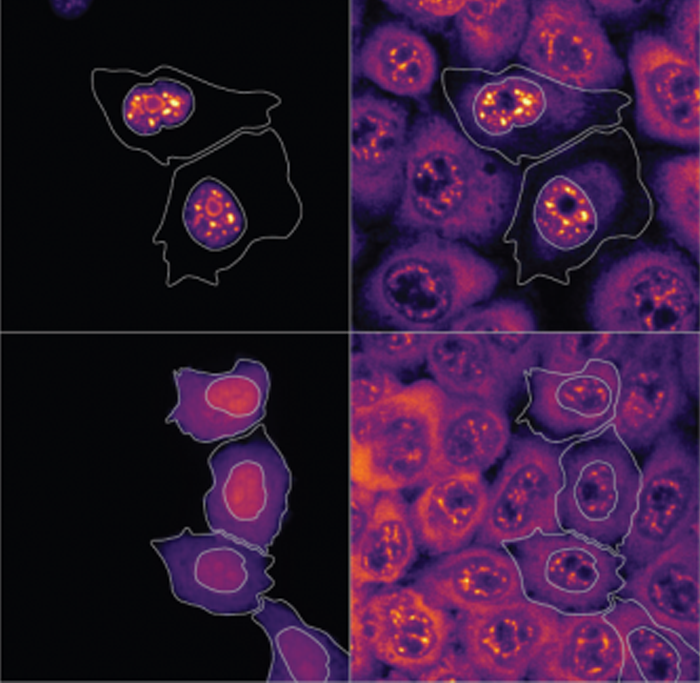
mage: Metabolic labelling with fluorescent dye indicates rate of RNA production. Image analysis measured the size, growth phase and rate of RNA production of every single cell

RNA metabolism tied to cell size

Inner workings of RNA concentration homeostasis in mammalian cells revealed with image-based genome-wide screening.
Microscopy image of lactating mammary gland tissue

Focusing on gender equity in STEM

By sharing a new-found love of microscopy, UNSW Sydney medical researcher, Dr Krystyna Gieniec is championing equity, diversity and inclusion in STEM.
  • Load More